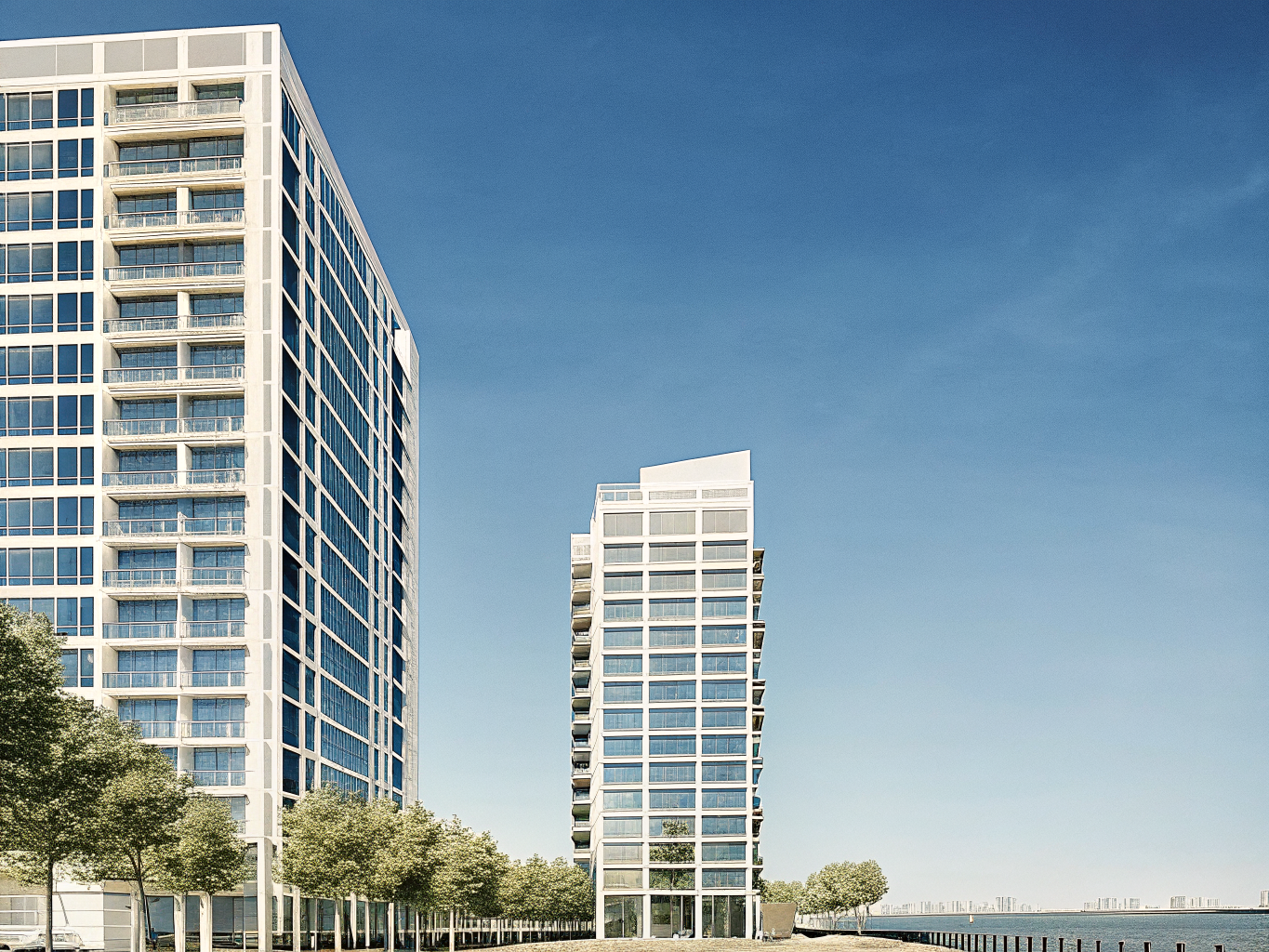
The Battery Park City Authority reached easement deals with three Rector Place buildings but not two — Liberty House and Liberty Terrace — pushing the north/west coastal resilience project past its 2030 target and keeping waterfront esplanade sections closed longer.
A $2 billion coastal resilience project in Lower Manhattan is heading for a partial redesign after the Battery Park City Authority failed to secure easement agreements with two Rector Place condominium buildings, setting back a flood protection effort that has been in the works since Hurricane Sandy struck in 2012.
The BPCA needs access to property below and around five residential buildings along the Battery Park City waterfront to complete below-ground flood wall work on its North/West Battery Park City Resiliency Project — a continuous barrier running from the southern tip of Manhattan north to Tribeca. Three buildings agreed: the Regatta, Gateway Plaza, and Hudson Tower. Two did not: Liberty House, at 377 Rector Place, and Liberty Terrace, at 380 Rector Place, according to reporting by The City Reporter. City records list LIBERTY HOUSE CONDOMINIUM and LIBERTY T.C. as the respective owners of record for those addresses.
Negotiations ran more than a year. The three cooperating buildings received per-unit compensation tied to construction duration — the dollar figure undisclosed — along with air and noise monitoring and coverage of any insurance cost increases. The two holdouts sought more money, design changes, and independent construction oversight. Liberty House's board of managers told The City Reporter it could not approve any deal because of unresolved "engineering, structural and building protection concerns." Liberty Terrace's board did not respond to press inquiries.
BPCA President and CEO Raju Mann said the authority will now redesign the project to avoid the two buildings' property lines. "We reached a point where we need to deliver this project, and this redesign will extend construction time and close public space for longer," Mann said. Construction on the north/west segment began late last year and was originally scheduled to finish around 2030; Mann did not give a revised target date.
The southern segment of the resilience project — a half-mile stretch from the Museum of Jewish Heritage to Bowling Green, including a redeveloped Wagner Park — remains on track for a September completion. The north/west section, once complete, would protect the neighborhood against coastal storms and an estimated 2.5 feet of sea-level rise projected by around 2050.
Manhattan Community Board 1 Chair Tammy Meltzer, a resident of a building that did reach an agreement with BPCA, described the tension plainly. "We're going to be living with this for five years," she said. "We need resiliency. … Extraordinary projects need extraordinary mitigation when they are at your home."
The esplanade sections adjacent to the stalled easement sites will stay closed for longer — a concrete consequence, in public square footage, of a private-property standoff over a public climate investment.
